
Simon Property Group competes in a fragmented market. There are many real estate investment trusts and many of them invest in the retail area. Simon has separated itself from the competition, however that doesn’t mean they are immune to the market. One of the largest threat to a retailer are expiring leases. Real Estate landlords thrive on long term leases with businesses that are thriving, since a bankrupt retailer will not pay their rent and short term leases add for mobility and increase the chance of vacancy. Simon has quite a bit of expiring leases coming up in the next three years. I pulled a list from their Q2 2019 8-K report.
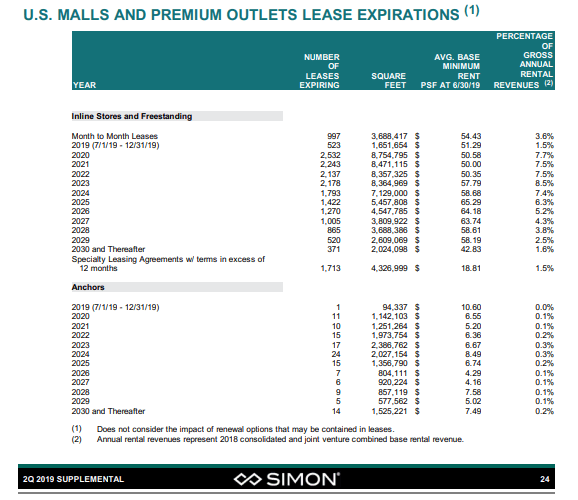
As you can see by 2021 there will be over 5,000 leases expiring, which means Simon will have to begin negotiating new terms hope the retailer is surviving in today’s modern world with the increase of internet shopping. Below are Simon’s largest tenants in their malls.
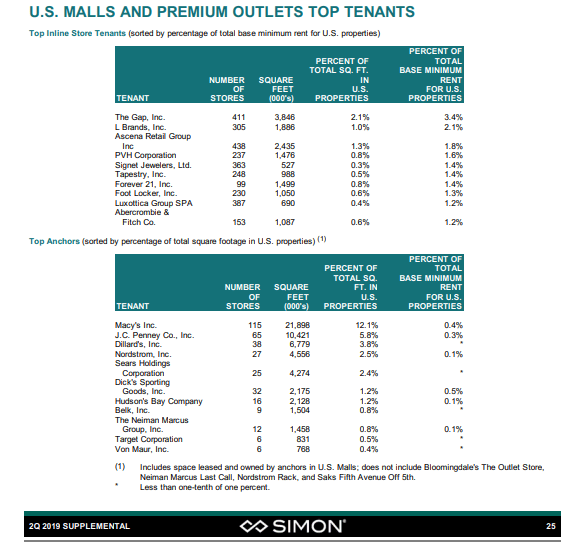
Anchor tenants are not typically the bread winners for malls, it is typically the “in-line” tenants since they pay higher rents and there are more. With a large Macy’s they may occupy 100,000 SF at $15 SF NNN ($1,500,000 annually), but if you have 100,000 SF of in-line space they are likely paying $25-$30 SF ($2-$3M annually). That is due to economies of scale and there are discounts given to anchor tenants since they drive foot traffic.
So how are Simon’s tenants doing financially? I ran financial numberes for their top two tenants, Gap and Ascena Retail Group (Ann Taylor, Lane Brant, Loft, etc.) Since September 24, 2018 (the past 12 months) Gap’s stock price has dropped from $27.70/share to $17.19/share (as of September 20, 2019), a 37% drop. Ascena Retail Group stock has dropped from $4.01/share down to $0.29/SF (as of September 20, 2019), a 92.77% drop! Renewal time is not looking pleasant for Simon and those poses a HUGE threat to them financially.
So how does Simon mitigate this risk? Chapter 4 discusses several areas they could look for help. 1) Process and product innovation. I discussed in previous posts how Simon is innovating the retail shopping experience. This is a huge driver for foot traffic and although Simon cannot control how Gap does business, they could help with making sure the foot traffic is there and give them an opportunity for success.
2) Have flexibility! Simon can think out of the box for rental agreements. It is not uncommon for small retailers to do a % of earnings as an escalator in their rent in return for a smaller monthly rent. Simon could pitch these companies and help reduce their overhead and help them focus on profits.
3) Work with Government regulations. In 2018 the Supreme Court reversed a sales tax law that requires any company doing X amount of business in a state (whether they are physically there or online) to pay sales tax. This was a huge win for brick and mortar retailers and brings the price comparison closer in-line and gives online retailers less of an advantage.
4) Strategize. Never get too comfortable and be an avid part of the marketplace. Reactive thinking can result in failure but being proactive sets you up for generations of success, which Simon is clearly an proactive company.
In closing, Simon has done and is currently doing all of the above, which is a huge reason for their continued success.
 Simon Property Group
Leave a comment