Blog Feed

Chapter 14 – Mergers and Acquisitions

Mergers and Acquisitions can make or break a real estate company. If you acquire bad assets than you run the risk of the previous owners problems becoming yours. Most real estate investors invest in what is called “value-add” properties. These are typically assets that are struggling in some way but the buyer sees how they can improve the property and flip it for a multiple in the future gaining a nice return on their investment. Institutional investors, like Simon Property Group, tend to stay away from these types of investments since they are risky. SPG likes performing assets that have positive cash flow so they can satisfy their investors and pay dividends. That doesn’t mean they don’t buy assets they hope to improve, it just means they stay away from the extremely risky properties.

Simon is a heavy acquisition company. Since 1993 they have completed over $40B in acquisitions according to Market Realist. Below are just a few of these acquisitions to highly.
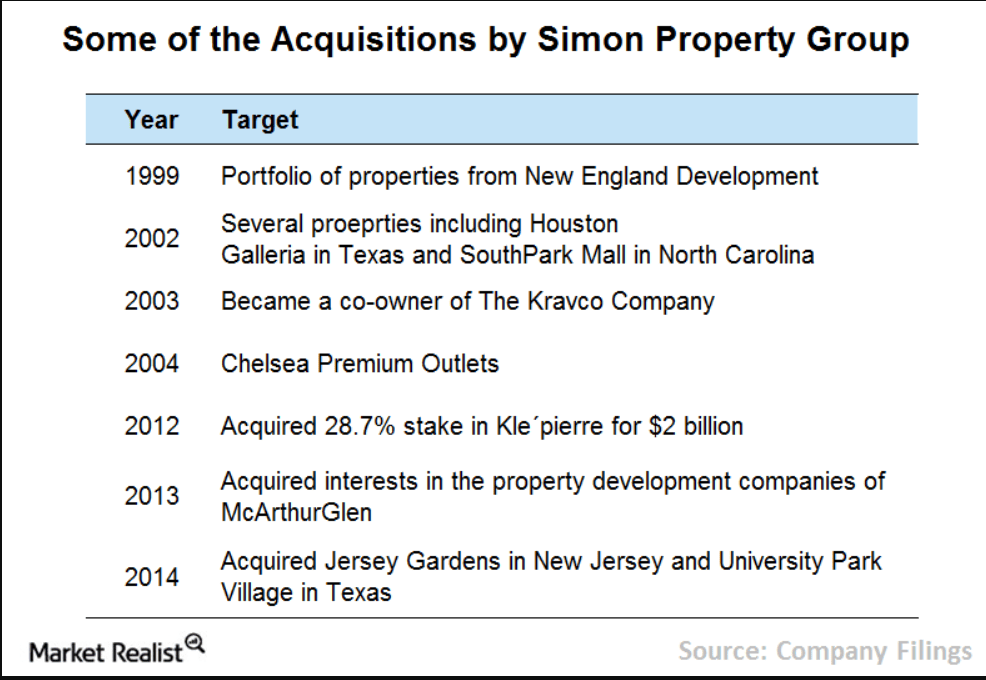
With over $40B in acquisitions, I believe it’s safe to say that they are an acquisition focused company. Where Simon differentiates itself is the type of acquisitions they do. They focus on strategic markets that fall into demographic categories conducive with what their retail tenant database are looking for. This assures them they can fill the space (or maintain) with retailers or other commercial use tenants. Focusing on these locations has its pitfalls though, such as paying a premium and sometimes at or above market value. Why would a company pay above value for an asset? In real estate that term is simple, Simon most likely sees a great opportunity for improvement in the management with an even greater upside potential if successful. Maybe they have large leases set to expire and Simon has relationships and knows how to get the tenants to renew their leases at or above their current rate. Or maybe Simon has an anchor tenant looking for a spot in a city and they feel they can attract that tenant to this location, which could have monumental affects on the in-line retail space and increase revenue for them.

M&A is a huge part of real estate and Simon has done a great job at being very strategic with what they buy and as a result they have been successful in an industry where others are struggling just to stay afloat.

Chapter 13 – Strategic Alliances

Simon Property Group is in a unique position in that it owns retail real estate, which is the hunting ground for advertising companies across the globe. Simon has several strategic alliances that are beneficial (and successful) to both them and their alliance partners.

One of their alliances is with EYE Mall Media. Simon entered into this alliance with EYE in 2010 , which provided EYE with exclusive advertising rights in Simon Mall’s. This is a huge benefit to EYE as they don’t have to compete with other companies for space and can receive the revenue from mall retail tenants (or non-mall tenants) that wish to advertise on digital signs to help drive traffic to their stores. In return, Simon is pleasing their tenants and providing them access to assistant in increasing sales at an affordable price (since they don’t have to go and take out an ad on a billboard that will broadcast to people not even shopping at the mall). Simon also receives advertising revenue from EYE from the exclusive deal so it is a win-win for both parties.

Another alliance Simon has is with The Coca Cola Company. In 2003 Simon Property Group entered into an exclusive agreement for Coca Cola to put their vending machines throughout Simon mall’s. The agreement also states that Coca Cola will do a large advertising campaign in the Simon Malls and has promotion opportunities, which is a huge benefit to a company like Coca Cola. The return benefit to Simon is they will have discounted (if not free) vending machines and guaranteed advertising revenue for its alliance with EYE Mall Media. The vending machines are a large cost but a necessity for customer satisfaction and the guaranteed advertising revenue benefits another one of its alliance. These are the types of alliances that are good and successful and stand the test of time.

Chapter 12 – Diversity

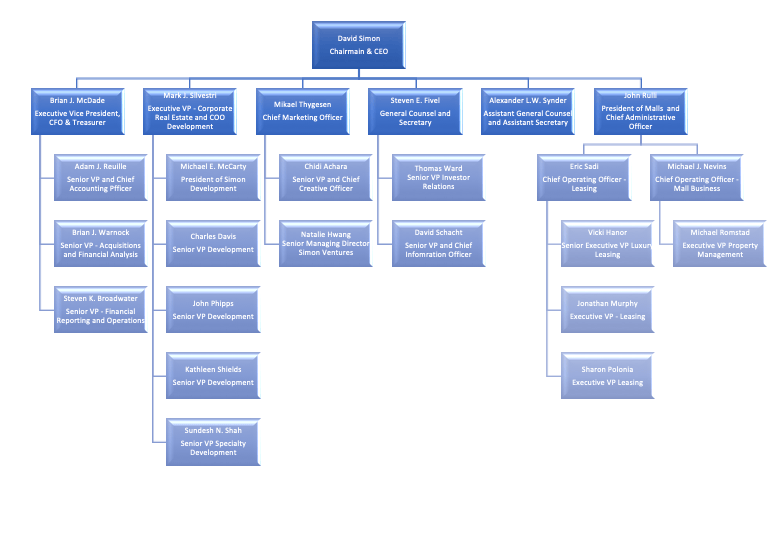
Having a diverse management is critical for a company to thrive and grow in a highly competitive industry like retail mall development. Simon Property Group has a diverse workforce and executive management. Below is a condensed org chart showing the makeup of Simon’s Executive Management

As you can see they have broken up the responsibilities quite well and have a variety of people overseeing or co-managing those operations. This allows the company to maximize efficiencies while capitalizing on their competitive advantages. There are additional areas they diversify and that is mall management. Simon breaks up the mall management between their premium outlets, mills brand, and regular malls. This is good because each have their own unique traits and targeted markets. The premium outlets are going for bargain shoppers that offer brand name retail at discounted prices. Mills is a type of mall Simon builds that has shopper experiences in mind and have both discount and regular retail. The regular mall is Simon’s regular development arm and although it is not the largest or most profitable of its lines, it targets a different audience than the other two mall lines and that is the reason for breaking up the mall division. Each division will have its own Executive management and they report back up through corporate. This is another reason Simon has prospered in an era where malls are dying and consumer shopping habits are changing.

Chapter 11 – Diversification

Simon Property Group has been diversifying its business strategy for many years. SPG is a retail mall developer and typically their tenant negotiations are with big box retail tenants and in-line mall tenants. It is not until recently that SPG has begun diversifying its tenant mix at their mall locations to help drive traffic. At the College Mall in Bloomington an defunct Sears was demolished and replaced with a Whole Foods. You do not typically expect to see a major grocery tenant at a regional mall, however it is this out-of-the box type thinking that has helped Simon Property Group weather the cyclical storms of retail and fight off online retailers such as Amazon.com.

In 2013 Simon Property Group did the opposite of diversifying and spun off it’s strip centers and small enclosed malls. Understanding complimentary business lines is important for the financial survival of companies. Sometimes diversifying isn’t always good and you need to backtrack and dispose of that idea before he negatively impacts you financially. In the case for Simon, the strip center tenants were different than the ones they were used to negotiating with. In addition, it’s a completely different type of management. You go from managing local smaller retail type tenants to large national financially healthy tenants. Simon noticed the differences and the fact their earnings were not what they were budgeting for and therefore divested those assets in order to focus on what they were good at, regional malls.

Sometimes diversification comes from the inside and isn’t as easily noticeable as an acquisition or divestiture. A number of years ago Simon made the business decision to eliminate the outsourcing of their property tax appeals. This doesn’t sound like diversifying, however by in-housing this function of tax you are bringing in a completely new line of services offered at your corporate offices. Simon went out to the marketplace and hired experienced retail property tax consultants and had to find a compensation commensurate with the results they will be bringing in. This is not typical for a major corporation this size to in-house appeals, however by doing this you are eliminating 25%-35% consulting fees. Based on conversations with Simon’s property tax director, they reduce their property taxes liability annually by $25M-$35M. If you were paying someone outside of your firm to do this it would cost anywhere from $6M-$12M. Imagine the savings you obtain by hiring employees direct, even if your overhead increases $1M annually, the net result will always be positive.

Chapter 10 – Vertical Integration

Simon Property Group is a major real estate investor, but unlike many real estate investors this company is vertically integrated into different facets of the real estate industry.

Most investors buy and sell real estate assets. They typically hire outside property management firms to run the day-to-day operations and do their financial reports. This allows the investor to focus on what they are good at, and that is identifying troubled assets and turning them into performers. This is how you get the most bang for your buck in real estate, it is called “value-add investing.”

Simon does their own property management. They have in-house leasing and do not outsource. Of course this doesn’t mean they shun brokers who are representing potential tenants, but their end is managed by in-house leasing staff, which gives them full control of the process and cuts out any commissions.

Another line of business Simon entered into was advertising. There is so much opportunity for advertising when you are a mall owner, however it’s amazing how many other major investors do not handle or do their own advertising. Simon has an entire department that’s dedicated towards not only advertising their own malls, but selling advertising space within the mall to anyone who wants to get information out to their customers. This is a huge revenue potential for the company and they have done well in capitalizing on it.

Last, Simon is not venturing into new alternative developments within their mall space to attract and bring customers into the centers. At the Sawgrass Mills mall in Sunrise Florida they built an AC Hotel by Marriott. This is great for out of town visitors and hotel guests are sure to utilize not only the retail stores but the restaurants and bars within the mall as well.

Being vertically integrated is risky for a business and cost you money if not done strategically. Luckily Simon has been very strategic with what they do and stay within the market they are accustomed to and familiar with and this is a big reason why they are successful despite the economic downtown for regional shopping malls.

Chapter 9 – Collusion

Simon Property Group is a REIT, Real Estate Investment Trust. They are landlords to some of the most valuable retail real estate in the world, and protect that investment through strategic decisions that garner appreciation instead of depreciation. Despite what people may think, there really is not a whole lot of collusion that could occur in real estate. Yes, the days of paying off Senators to block rezoning or deny certain licenses did exist and was huge, especially in real estate. But when you are operating retail real estate it is a different animal. You are solely reliant on your tenants to pay their annual rent and CAM (common area maintenance) charges in order to remain profitable. In order for that to occur you need your tenants to make money, otherwise they will go broke and a bankrupt tenant does not pay rent.

In order to collude on investments SPG would need to disrupt any other investors chances from entering the discount mall industry. There are many discount malls but what makes SPG a solid investment (for both investors and tenants) is their focus on technology, site location, and access to capital. The area where collusion could exist (although we would never know since it would be illegal) is in the site location. SPG owns prime real estate, which is very expensive. I suppose during the bid process for a site if there were multiple locations of a potential outlet mall, SPG could collude with its tenants to offer incentives on why they should sign LOI’s (letter of intents) with them and deny signing an LOI with a competitor. After all, wouldn’t any retailer love a discount on rent at multiple sites (an offer SPG can easily offer) vs one? In addition, SPG could work with local politicians to deny the competitor from being able to acquire or get the necessary approvals to develop the mall. These types of things I’m sure do occur, however they are not in the lime light as it would be a huge negative to Simon.

What did make news recently was Simon’s collusion with discount retailer Walmart in an initiative to bring to light things about Amazon in an attempt to block Amazon’s growth and steer the benefit towards themselves. This was the subject of a September 2019 Wall Street Journal article that said:

“Free and Fair Markets accused Amazon of stifling competition and innovation, inhibiting consumer choice, gorging on government subsidies, endangering its warehouse workers and exposing consumer data to privacy breaches. It claimed to have grass-roots support from average citizens across the U.S, citing a labor union, a Boston management professor and a California businessman.

What the group did not say is that it received backing from some of Amazon’s chief corporate rivals. They include shopping mall owner Simon Property Group Inc., SPG 0.73% retailer Walmart Inc. WMT -0.05% and software giant Oracle Corp. ORCL -0.17% , according to people involved with and briefed on the project. Simon Property is fighting to keep shoppers who now prefer to buy what they need on Amazon; Walmart is competing with Amazon over retail sales; and Oracle is battling Amazon over a $10 billion Pentagon cloud-computing contract.”

Collusion comes in many ways and the old ways for real estate may have died, but that doesn’t mean survival doesn’t find a way to compete.

Chapter 8 – Flexibility

In chapter 8 we learned how to understand the financial side of strategy and understanding risk and ways to quantify cost/benefit or opportunities. Whether it is identifying direct risk and the financial projection from a strategy, or an indirect risk and/or indirect financial gains from a strategy, there is opportunity and multiple ways to look at it.

Simon Property Group is a REIT, and therefore risk is everywhere and Simon has done a great job in minimizing risk or tackling risk. The financial pro-forma’s they use is highly confidential as competitors with their same projections could beat them to the punch. So how does Simon assess risk?

  1. Simon looks at their portfolio as a whole and identifies properties where competition can gain an advantage. This could be through newer nicer common areas and better tenant mixes to security and safety of shoppers. In 2018 Simon invested $600 million back into their developments with an average yield of approximately 8%. That is an impressive number with rates of returns any company would be glad to see. Simon takes the stance that having highly desirable properties in high desirable locations will drive traffic no matter what the competition is doing and they are proving to be right and are maintaining it with investments into capital.
  2. Simon grew its Simon Insider loyalty program members by 30% and those members spent an average of 20% more! Growing a loyalty program is not easy. It requires a lot of strategy and financial analysis to see the cost/benefit of catering sales/discounts/etc. to specific members but the performance metrics seem to be going well.

Strategy is important and understanding the financial impact and having flexibility to pivot is key for a business successfully implementing strategy. Like my boss always says “show me the analysis of why you think this is a good idea.” We may not have access to Simon’s analysis but I can almost guarantee it’s there and it’s in depth.

Chapter 7 – Product Differentiation

The key to success in a business is not to only make a profit and sell something consumers want, but also to differentiate yourself from the competition so you have something no one else does. When you are a mall developer differentiating yourself could be hard because you are building something your consumers (retailers) are used to and the unknown is never a good place retailers like to explore. Simon has done a great job in inventing a shopping experience that adds to the consumer experience and is something new and exciting that their competition is not doing.

Simon created next generation digital directories that allow consumers to search for stores and even get directions and have them texted to their phones. This adds for convenience and shopper gratification.

Simon has also created an application to reserve parking spots at the malls. This is huge in areas where parking is scarce or during busy shopping times like weekends and holidays.

Simon has already created a Facebook messenger bot that allows shoppers to text and ask questions about stores, restaurants, sales, and other information on stores within the mall.

Simon is currently rolling out its new Digital Voice Translator for non-English speaking shoppers, which adds a huge benefit to retailers to help and assist in increasing sales. A happy customer is more like to spend money if they can ask questions about a product and gather the information needed to make an informed purchase.

Simon has also created Dropit, which allos customers to drop of packages or bags at a Dropit location in the mall so they don’t have to lug around multiple things all day. Then when they are ready to leave Dropit will deliver the packages to them for free.

As you can tell there are so many interesting and cool things Simon is doing to differentiate the shopping experience, which may be one reason why the malls continue to thrive in an otherwise dying industry.

Chapter 6 – Cost Leadership

In Chapter 6 we learned about Cost Leadership and how companies can excel over competitors (or struggle) as a result of costs associated with business. These costs can come in the form of an advantage or a threat and need to be aligned with Management in order to fully be taken advantage of.

Simon has several “costs” that can be an advantage or a threat.

1. The cost or threat of entrants into their line of business is high, extremely high.

I don’t think the average person knows what all is associated with developing a retail shopping center in today’s environment. Think of it as a buyers market for housing in real estate, except in retail the number of buyers is extremely small and the number of supplies is overwhelmingly high. Simon has invested in “Class A” locations that are highly desirable with a tract record of retail success. Example: I live in Nashville, TN and Simon owns the Opry Mills Mall, which is one of their highest grossing retail centers in the Country. Opry Mills is not located downtown or the heart of the central business district, it is off site about 10 miles away. So why has this been so successful? Well, for starters it is attached to the Gaylord Opryland Hotel as well as the Grand Ole’ Opry. These two places alone bring hundreds of thousands of tourists each week to the area and what better way to “kill” time than to walk an outlet mall. For this to be replicated in Nashville would costs hundreds of millions of dollars and the right partners (or in this case, nearby attractions) for it make sense so the barriers of entry to compete are stiff.

2. Threat of substitute is high. As much as barriers to entry being a cost advantage, it could also be a huge threat. What do you do if you can’t afford to compete with the “big guys?” You create an alternative and don’t compete directly, but indirectly. The threat to online shopping is the single most frightening threat to the retail industry. If you eliminate the overhead expense you can afford to sell items with smaller markups and reduce costs that eliminate the need to even go in a store, which is why the threat of substitute is such an important focus point for retailers.

Other costs advantages Simon has is its economies of scale, cash availability, and technology. Simon has the ability to control operating expenses easier due to its sheer size and with the success it has had, is able to pay a very attractive $8 dividend (has increased $5 over the past 7 years) or 5.3% annualized return on your investment. Last, with its economies of scale it also has the ability to research in R&D and excel technology that has improved efficiency and provided competitive advantages.

These are some of the cost advantages or threats Simon Property Group has and the company management does a great job in capitalizing on the advantages and minimizing the threats.

Chapter 5 – Evaluating Firm Strengths and Weaknesses

In Chapter 5 we learned about different ways to identify strengths and weaknesses. For this weeks blog I am going to focus on the VRIO (value, rarity, imitability, organization) Framework.

VRIO takes an organizational activity in which a firm engages in and asks several questions and this will determine if the activity is a strength or weakness for the organization. For Example: If a company spent a lot of money of research and development for a product that does not have vertical or horizontal integration possibilities and a competitor enters the market. You are exposing risk to your firm by not having the opportunity to grow the product through other resources and thus begin a pricing war with the competitor vs a value war.

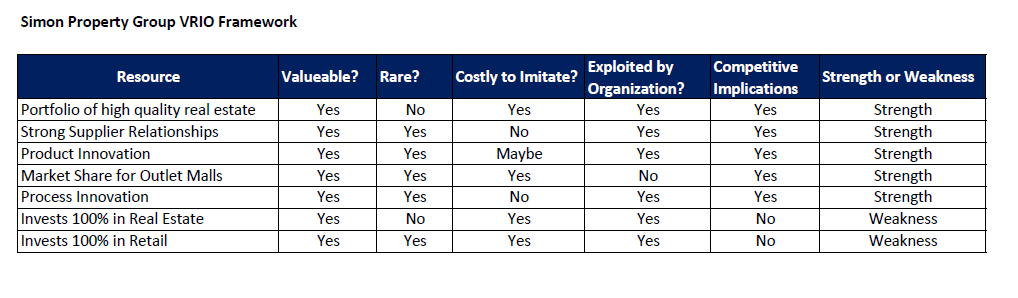
The following is a VRIO for Simon Property Group on resources I feel the company has and/or actions they have taken throughout their life.

I will begin with analyzing Simon’s portfolio of high quality real estate. Is having a portfolio of high quality resource a value to Simon or potential threat? This was is a little obvious, it is a strength. In real estate their are two types of investors: 1) value-add 2) quality. Value-add investors have tremendous potential of taking a dilapidated property and renovating it and taking (hypothetically) $100 and turning it into $1,000,000. Quality investors focus on properties in prime markets with quality tenants that have low risk of default, these are typically REIT’s (real estate investment trusts) that are investing on behalf of institutional investors and guaranteeing a dividend on their investment.

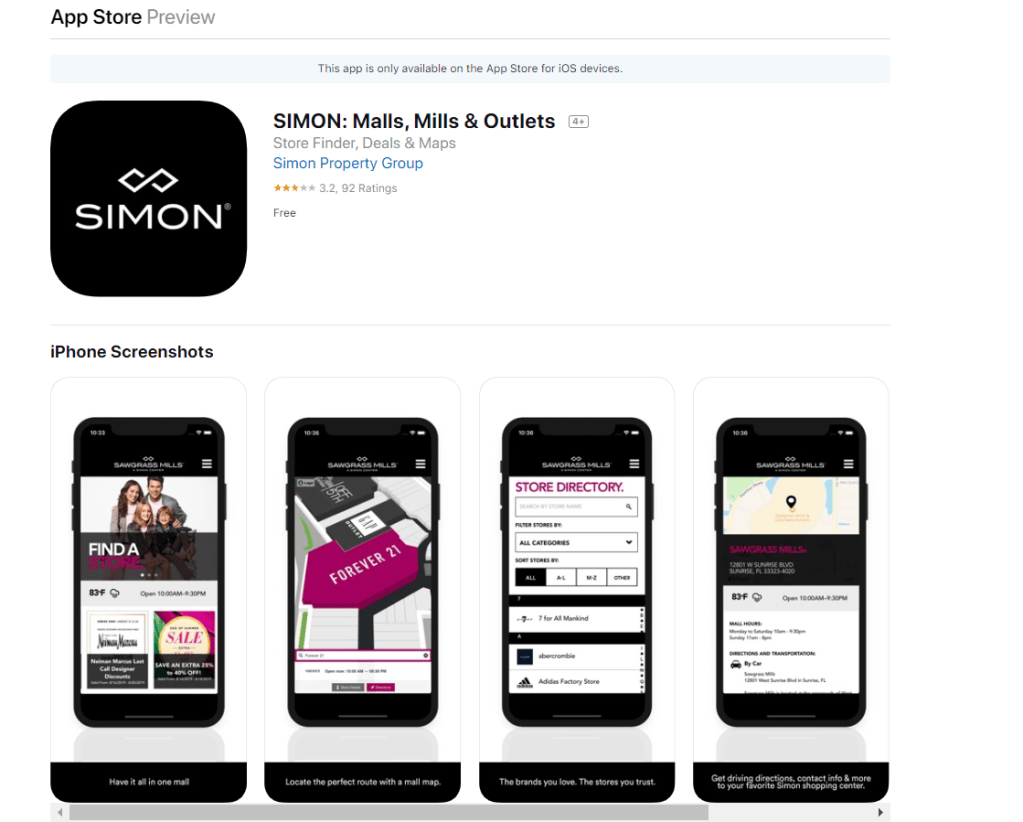
If we look to another resource like product/process innovation we can also analyze if it is a strength or weakness. When a company innovates a product/process in real estate, it can generally be replicated by another firm. Example: Simon built a mobile application that allows shoppers to browse their malls, locate stores/restaurants, and see any/all sales. This was not available before Simon brought it to the market place and became a game changer for the company.

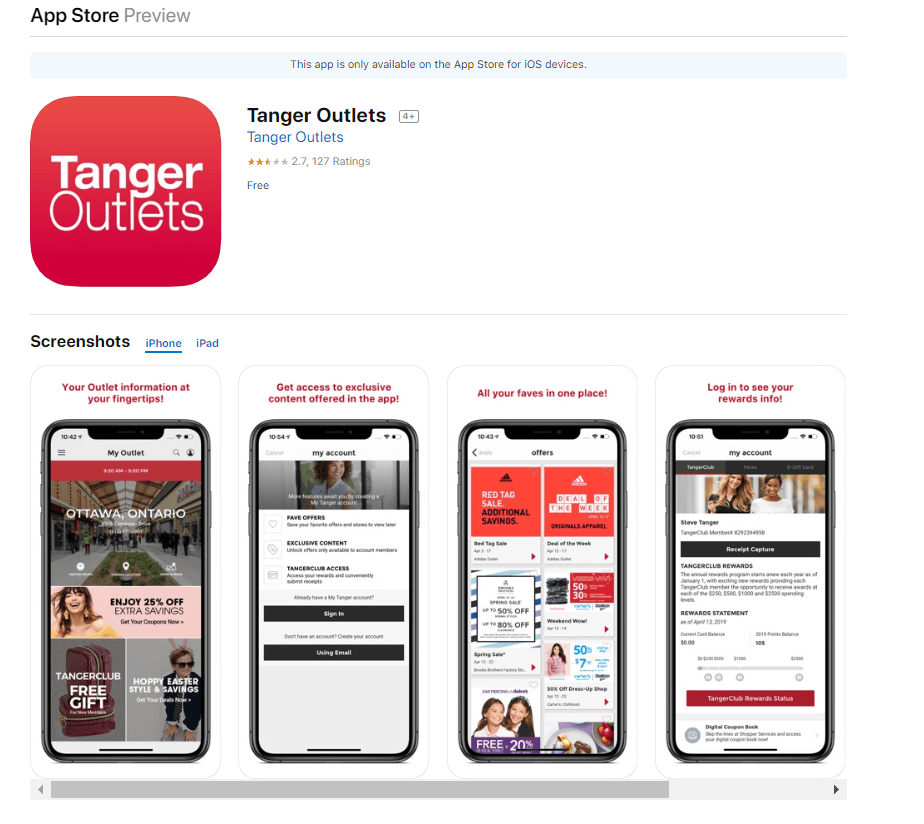
Just like anything good, it always comes in twos and shortly after their largest competitor Tanger Outlets followed in their footsteps and did the exact same thing.

Product and process innovation could be both a strength and weakness since you are the company spending the money and resources innovating only to have it copied by someone and they spend substantially less and keep the net profit, however first to market does have its advantages and for that reason I am saying it is a strength.

Simon Property Group is a real estate investment company and therefore all of their business is focused on the investment of commercial real estate, which in itself makes it focused and an expert in its field, however it also opens the company to fluctuations in the marketplace.

In 2007 I was studying real estate at the University of Arizona and my professor brought in a real estate developer to talk about one of his master plan projects. This developer was discussing his pro-forma assumptions and saying how if “you build it they will come.” I raised my 21 year old hand up and said “what about when the next recession hits and they don’t come?” The developer laughed and said “great question, have you looked at the stock market lately? There are signs that lead to a recession and we are not headed towards one anytime soon so the assumption is still applicable.” 18 months later that developer was probably biting his own words trying to figure out how to survive one of the darkest periods in real estate history.

Investing in real estate has its pros and cons. The pro is you are an expert and typically know your market. It is very expensive to copy others investment moves and requires a lot of capital, however because you build a Class A property on the corner of X and Y street does not prohibit your competitor from doing the exact same thing across the street. Also, as can be seen today, government actions like tariffs can drastically affect your outlook and require you to alter your business model. Change in consumer behavior (like online shopping) can also rapidly change and all of a sudden what you thought was a high quality investment has turned into an investment full of bankrupt tenants.

Simon has done a great job focusing on their good resources and growing them, like innovation and market share or building strong and lasting relationships with their national tenants. For that reason I believe them to be healthy and have more strengths than weaknesses, at least for the areas I focused on.

Blog at WordPress.com.

Up ↑

Design a site like this with WordPress.com
Get started