Chapter 4 – Evaluating Environmental Opportunities

Simon Property Group competes in a fragmented market. There are many real estate investment trusts and many of them invest in the retail area. Simon has separated itself from the competition, however that doesn’t mean they are immune to the market. One of the largest threat to a retailer are expiring leases. Real Estate landlords thrive on long term leases with businesses that are thriving, since a bankrupt retailer will not pay their rent and short term leases add for mobility and increase the chance of vacancy. Simon has quite a bit of expiring leases coming up in the next three years. I pulled a list from their Q2 2019 8-K report.
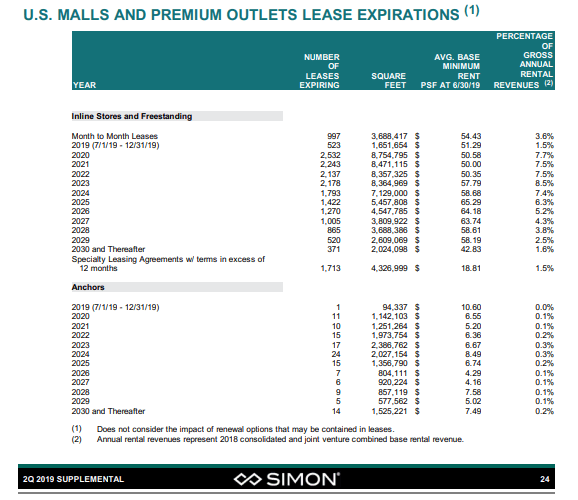
As you can see by 2021 there will be over 5,000 leases expiring, which means Simon will have to begin negotiating new terms hope the retailer is surviving in today’s modern world with the increase of internet shopping. Below are Simon’s largest tenants in their malls.
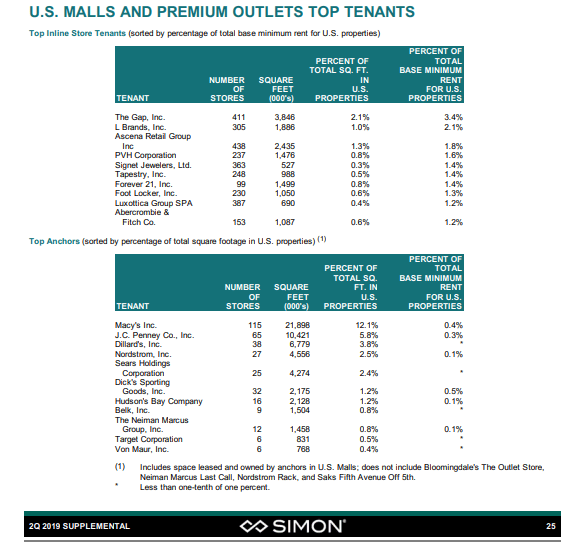
Anchor tenants are not typically the bread winners for malls, it is typically the “in-line” tenants since they pay higher rents and there are more. With a large Macy’s they may occupy 100,000 SF at $15 SF NNN ($1,500,000 annually), but if you have 100,000 SF of in-line space they are likely paying $25-$30 SF ($2-$3M annually). That is due to economies of scale and there are discounts given to anchor tenants since they drive foot traffic.

So how are Simon’s tenants doing financially? I ran financial numberes for their top two tenants, Gap and Ascena Retail Group (Ann Taylor, Lane Brant, Loft, etc.) Since September 24, 2018 (the past 12 months) Gap’s stock price has dropped from $27.70/share to $17.19/share (as of September 20, 2019), a 37% drop. Ascena Retail Group stock has dropped from $4.01/share down to $0.29/SF (as of September 20, 2019), a 92.77% drop! Renewal time is not looking pleasant for Simon and those poses a HUGE threat to them financially.

So how does Simon mitigate this risk? Chapter 4 discusses several areas they could look for help. 1) Process and product innovation. I discussed in previous posts how Simon is innovating the retail shopping experience. This is a huge driver for foot traffic and although Simon cannot control how Gap does business, they could help with making sure the foot traffic is there and give them an opportunity for success.

2) Have flexibility! Simon can think out of the box for rental agreements. It is not uncommon for small retailers to do a % of earnings as an escalator in their rent in return for a smaller monthly rent. Simon could pitch these companies and help reduce their overhead and help them focus on profits.

3) Work with Government regulations. In 2018 the Supreme Court reversed a sales tax law that requires any company doing X amount of business in a state (whether they are physically there or online) to pay sales tax. This was a huge win for brick and mortar retailers and brings the price comparison closer in-line and gives online retailers less of an advantage.

4) Strategize. Never get too comfortable and be an avid part of the marketplace. Reactive thinking can result in failure but being proactive sets you up for generations of success, which Simon is clearly an proactive company.

In closing, Simon has done and is currently doing all of the above, which is a huge reason for their continued success.

Chapter 3 – Evaluating Environmental Threats

Simon Property Group is a REIT. There are many REITs in the Country and some invest in a variety of assets while others specialize. Simon specializes in outlet shopping centers. With over 251 million square feet under their ownership, Simon is not only the largest outlet mall owner in the U.S., it is the largest shopping center owner in the U.S. The competition could best be described as Perfect Competition, since there are small barriers to entry and there are many competitors.

With that being said, there are also many threats Simon must overcome if it wishes to remain on top. 1) Threat of rivalry. Simon has built relationships with many retailers and can utilize its size and power to stronghold retailers into not opening up shops in competing nearby malls. Example: Ralph Lauren wishes to move its store from Small Town Outlets to Urban Outlets (hypothetical names), however Simon does not own Urban Outlets and tells Ralph Lauren that if it wishes to vacate their space there may be repercussions in the 47 other leases it has with Simon Property Group. Since Simon is so large it is very difficult for a small (or large) investor to make fast and impactful moves against the company, however there really isn’t anything stopping another REIT from entering and making a dent in Simons earnings.

Another threat is the Threat of Substitutes. Right now the average normal shopping mall is crumbling as we speak. Vacancy is at an all-time high and there is no end in sight due to online shopping. Appraisers have dubbed a term known as “dark store” that depicts large big box retail stores closing and remaining “dark” for long periods of time with their highest and best use being alternative retail (i.e. a church, charter school, storage units, etc.). Online shopping crumbled the average retailer but outlet retailers have squeezed by relatively untouched….for now.

There is nothing out there that prohibits Amazon from selling the exact same items the retail tenants in a Simon mall are selling. In fact, sometimes they do. The term “outlet” sounds nice, and inexpensive, and a deal. Is that the reason they remain successful? It may be, or possibly the real reason truly is Simon management and knowing how to continue to attract customers and foot traffic. Regardless, the threat of substitute is extremely high in retail real estate and I am sure Simon is working on how to combat that with shopping experiences, which is something you won’t get when clicking on “buy” from an online retailer.

Chapter 3 essentially goes over Porter’s 5 forces model and the two I feel are most relevant to Simon Property Group are Threats of Entry and Threats of Substitutes. I believe I have explained how these relate to Simon and where they should be paying attention to prevent a decline in revenue as a result of the threats.

Chapter 2 – Competitive Advantage

Strategy in business, sounds almost like a necessity right? How can a business run successfully if it doesn’t have a strategy? Oh I know, it doesn’t! Companies spend millions of dollars each year refining strategy and doing market research, running data analytics, hiring Consultants to forecast change, etc., all with the intent to improve profits for shareholders (if they are publicly traded) and GROW!

I took what I learned on strategy from Chapter 1 and researched how Simon Property Group (SPG) uses it and how they use it to further their competitive advantage and in turn their financial performance. First, what’s the mission because clearly the mission says everything I need to know. Surprisingly I spent a good 30 minutes searching for it and could only find it on some third party website and even though this is just a blog, I would prefer not to blog potential fake news.

So what is Simon’s mission and does it show their strategy? Well, your guess is as good as mine but I combed over their 2018 Annual Report to try and find what their strategy is and found it and they are:

  • Focus on the ownership of high-quality retail real estate
  • Increase presence in major metropolitan areas
  • Own assets along the price spectrum of retail real estate, dealing with the barbell effect (from value to luxury consumers)
  • Lead the industry in promoting their shooing destinations as “Marketing Medium” and connecting with the community and consumer directly and being less reliant on retailers to do that
  • Densify well-located real estate with elements that foster a live, work, plan and stay environment including apartments, office, hotels, entertainment, restaurants, and health and wellness
  • Lead the industry in successful and profitable acquisitions where value can be added
  • Export their “know-how” internationally

Wow, that is a lot of information to grasp and can really go many ways. I am not here to critique their strategy but rather review exactly what they are doing and does it match who they are as a company. Simon is a mall developer and by now almost everyone in America is aware the mall industry is struggling. Retailers are going out of business and consumer demands are rapidly changing, so how is it that Simon has managed to weather the storm and continue to turn profits in an otherwise dark industry. The answer is simple, clear concise focus on what they want and how they are going to get there. That is the definition of strategy. Do I know if increasing a presence in a major metro area will drive profits? No, but do I know Simon has focused on that and followed through (at least in 2018/2019) with that goal in mind and profits have gone up, yes!

So now how does Simon use this towards their competitive advantage?

In doing research on a REIT (real estate investment trust) it is only common to see goals of acquiring net positive investments or doing remodels/expansions on the target areas for improvements, but innovations? My eyebrows went up when I saw innovations on targets for improvements and dug in to see exactly what that meant. Simon (it turns out) is an innovator when it comes to the shopping experience (explains why they are doing so well). In 2018 they focused heavily on their “online” presence and creating a consumer experience that drove traffic to their malls. They did this with digital platforms, mobile applications that allowed consumer to order food (since malls always have options but everyone hates fighting traffic to go there just to eat), applications geared towards parking maps (another big problem in the mall industry – finding parking), and just overall changes geared towards consumer interaction with the mall itself and not just a store. It’s unique but it is working.

In addition, Simon has focused exclusively in outlet malls vs traditional retailer driven malls. An outlet mall sells name brand clothing at a discount. I personally think it is crazy to go to Dillard’s and pay $75 for a Ralph Lauren polo when you can go to a Simon outlet mall with a Ralph Lauren Outlet in there and buy that same shirt for $40. Simon has created a big advantage to its competitors by focusing on discount retailers and driving foot traffic where other stores are burdened with the non-stop price comparing with Amazon or other online retailers.

So just how has Simon’s decisions helped them stand out from the competition? Let’s take one of their major traditional mall retailer competitors, Macerich.

Simon Property Group

2018 Total Revenue Growth +1.8%
2018 Net Income +20.2%

Macerich

2018 Total Revenue Growth -2.6%
2018 Net Income -143%

The numbers in the comparison speak for themselves. Macerich owns a lot of malls throughout the Country and are a massive billion dollar REIT out of California that knows what they are doing, unfortunately they have fallen victim to the online shopping shift and their financials are showing it.

In chapter 2 we learn a lot about a companies competitive advantage and how it can impact their financial performance. Simon has clearly shown they are doing things (or creating things) that make their shopping centers stand out from the rest of them. Whether it’s innovating the shoppers experience or focusing on retailers that typically drive higher foot traffic and what they are doing is working. Simon’s YE 2018 net earnings was up 20% from 2017 and almost 25% from 2016! That’s growth and numbers any business would love to see.

About the blogger

My name is Nick Ruiz and I am an MBA student at The University of Memphis and this blog is part of MGMT 7160.

I was born in California but raised in Arizona. I relocated to Nashville, TN in 2015 for work and love the change of environment from desert heat to southern humidity. People here think i’m crazy for loving the humidity, but I would take sweat over scorching skin any day!

I work in the healthcare industry and have chosen this semester to follow Simon Property Group. I have always loved real estate (especially commercial real estate) and even though the retail industry has changed and yesterdays malls are now dead, Simon has managed to thrive in an otherwise dying industry. I hope to learn more about the company as I dig in to their operations and hopefully my readers will too.

I am huge University of Arizona sports fan, although NOT living in Mountain/Pacific time has its pitfalls since every game/tip off is 9:00 PM or later.

In addition to UA, I absolutely love the New England Patriots and even named my son after the one-and-only Tom Brady.

Blog at WordPress.com.

Up ↑

Design a site like this with WordPress.com
Get started